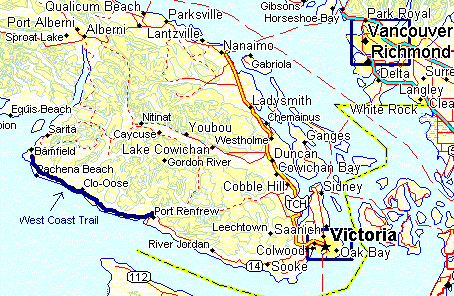
In early July 2016, my friends and I will be hiking the West Coast Trail, in the Pacific Rim National Park on the southwestern edge of Vancouver Island, with two guides from Sea to Sky Expeditions. Our itinerary, map and details can be found at http://seatoskyexpeditions.com/hiking/west-coast-trail-graveyard-of-the-pacific-backpacking/. It is considered one of the world’s top ten hikes and is rated as strenuous.
The group is made up of eight very different women who share great senses of humour and adventure. My cousin, let’s-just-get-going Juli, is joining us from Denver, Colorado. My cottage friends from Stony Lake — I’m-just-feeding-40-for-dinner Colleen, make-you-laugh-until-you-pee Louise, super-carpe-diem Connie, and I’ll-paddle-you-rest Sue — reside in Toronto, Collingwood, and Whistler. My Toronto book clubbers, philosopher-friend-at-the-ready Pat and I’m-turning-50-and-this-is-my-gift-to-myself nurse Janis, round out the group.
We will start at Port Renfrew and tackle the most challenging part of the trail first as we make our way 76 km north to Bamfield. It will take us 9 days to complete, after which we’re hitting the Willow Stream Spa at Vancouver’s Pacific Rim Hotel to get massages, eat a decent meal, and drink…
Citing Wikipedia, “The trail is still extremely rugged and requires a high level of fitness, knowledge and skill to complete, although in the last 10 to 15 years it has been upgraded to facilitate hiking and safety for those with less experience. This has changed the nature and challenge of the trail somewhat, but has made it easier for hikers to explore the coast. It has been recommended that hikers travel in groups, as a measure of safety, but some hike the trail solo. To cross the larger rivers and streams hikers must ride cable car suspensions, while smaller or slower waterways are bridged only by fallen logs, or may even require wading. There are two waterways that require a boat to cross: the Gordon River, at the southern trailhead, and the Nitinat Narrows, near the midpoint of the trail. A ferry service is operated by the local First Nations. The trail includes some three dozen-ladder structures, some of them 30 feet (9.1 m) high, that hikers must ascend or descend. Approximately 6,000 backpackers complete the trail every year, with one to two per cent requiring emergency evacuation due to injury, illness, or hypothermia.”
For my fellow backpackers, here is a list of the big item gear that I’ll be taking for this challenging rainforest trip where, besides not slipping backwards, keeping dry is one’s greatest priority:
- Osprey 75L Backpack (purchased at Atmosphere)
- Arc’teryx Alpha SL Goretex Pro packable jacket
- ZPacks Ultralight Rain pants zpacks.com
- Sierra Designs 3 Season Women’s Mobile Mummy Sleeping Bag 600 Fill with Duck DriDown http://sierradesigns.com/product/mobile-mummy-600-3-season
- 1 pair Waterproof/Windproof Goretex Socks sealskinz.com
- Asolo Power Matic 200 GV Backpacking Boots http://www.mec.ca/product/5021-354/asolo-power-matic-200-gv-backpacking-boot-womens/?q=asolo
- Titanium Pocket Spork & Mug
- Hiking Poles
- Goretex Gaters with Velcro
- 2 Fleece Lined Hats
- 3 pair KnixWear Air Moisture Wicking Underwear that can double as my bathing suit bottoms knixwear.ca and can handle multiple days of wear
- Nike Pro Hero Sports Bras
- Bum Pad for Campsite
- Inflatable Cervical Camping Pillow (my one luxury)
- Thermarest
- Columbia Back Beauty Pants with Omni Shield
- Mountain Hardwear shorts
- 2 Quick wicking, Merino-hybrid t-shirts
- Packtowl Ultralite Towels (Large and Small)
- Collapsible Plastic Bowl
- Silk/Merino Wool Hiking Socks
- 2L Water Bladder (from my Camelbak Knapsack)
- Nalgene 1L Bottle
- Swiss Army Knife
- Duct Tape
- Band-Aid Blister Packs
- Ballcap
- Gardening Gloves
- Cellphone for Pictures, with small portable charger
- $30 cash; one credit card
- Petzl Tikka Headlamp with fresh batteries
- Hand sanitizer
- Small notebook and pen
- Sunblock, chapstick, comb, wipes
- Glasses; extra set of contact lenses; old Oakley polarized sunglasses & strap
- Neck fleece bandana/gaiter
- Stony Lake Buff (which I never took off in Algonquin!)
- First Aid Kit
- 1 Roll Toilet Paper w/out cardboard insert & plastic ziplock bags
- Compression bags, Drysacks, Garbage bags
- Bear Spray
- Polypropylene long johns: top & bottom for sleeping
- Primaloft Light jacket and vest
- North Face Thermaball Jacket
- Mountain Hardwear Wind jacket
- Probiotic & Medication & Advil
The goal is to keep the pack to 30 lb. Sea to Sky advises that we’ll each be carrying 7-8 lb. of food and 3 lb. of tenting gear.
I’ve been breaking in my Asolo boots since September (and loving them), wearing them through the snow, rain, sandy beaches, and mud. Now, I’m strapping on my backpack and starting conditioning, gradually adding weight. Here is the regimen:
| WEEK | Monday | Tuesday | Wednesday | Thursday | Friday |
| 1-2 | Walk or jog a course with rolling hills. 30 min. Carry 2 kg/5lb to 4.5 kg/10 lb in pack. | Strength, Balance, Endurance Training | Rest | Strength, Balance, Endurance Training | Repeat Monday. |
| 3-4 | Same. 45 min. Add 2kg/5lb | Strength, Balance, Endurance Training | Rest or cross-train. 30 min. | Strength, Balance, Endurance Training | Repeat Monday |
| 5-6 | Same. 60 min. Add 2kg/5lb | Strength, Balance, Endurance Training | Rest or cross-train. 30 min. | Strength, Balance, Endurance Training | Repeat Monday |
| 7-8 | Same. 60-90 min. Add 2kg/5lb | Strength, Balance, Endurance Training | Rest or cross-train. 30 min. | Strength, Balance, Endurance Training | Repeat Monday |
I’ll report again once we’ve finished the trail and are in the truck heading back to the ferry!
 TREDSUP